


A curriculum is a programme of content to be taught and learnt – a course of study for schools, colleges and universities. Schools in England follow the National Curriculum – a course of study decided by the Department for Education. (Private schools, academies and free schools are exempt: they don’t need to follow the requirements.) Learn more about the National Curriculum with this overview.
Our Curriculum Guides set out our curriculum intent and how we implement it. They describe our curriculum and age-related expectations.
- Reading Curriculum Guide and for Phonics and Early Reading, check out our Phonics page
- Writing Curriculum Guide – and read our Handwriting Guide and Spelling Guide on the Help your child in Reading and Writing page
- Maths Curriculum Guide
- Science Curriculum Guide
- Living and Learning Curriculum Guide – this relates to Personal, Social, Health and Economic Education and other ways we support pupils’ personal development
- Living and Learning: Feelings First – this is a guide to one element of our Living and Learning curriculum
- Topic Curriculum Guide– this relates to Art, Computing, Design and Technology, Geography and History
- Art Curriculum Guide
- Latin Curriculum Guide
- Music Curriculum Guide
- PE Curriculum Guide
- RE Curriculum Guide (and the locally agreed Religious Education Syllabus)
- Design and Technology: Food and Nutrition Guide – this includes recipes (please check in case your child has any allergies we should know about)
For Reception, check out our Early Years page.
To meet the requirements of the National Curriculum, all classes in Key Stage 1 and 2 follow some set, pre-planned topics. At Moortown Primary, we make sure children learn lots of additional skills, knowledge and understanding, too. For example, we offer a range of after-school clubs and opportunities to learn a musical instrument or try a new sport – these extra-curricular activities go beyond the statutory requirements. (Encourage your child to join in!) Current local / national or international events can also provide a great basis for learning.
The topic plan for each phase is set out below (this is an extract from our full Topic Curriculum Guide). ‘Year A’ are ‘odd years’: 2025-26, 2027-28, 2029-30… and ‘Year B’ are ‘even’: 2026-27, 2028-29, 2030-31…
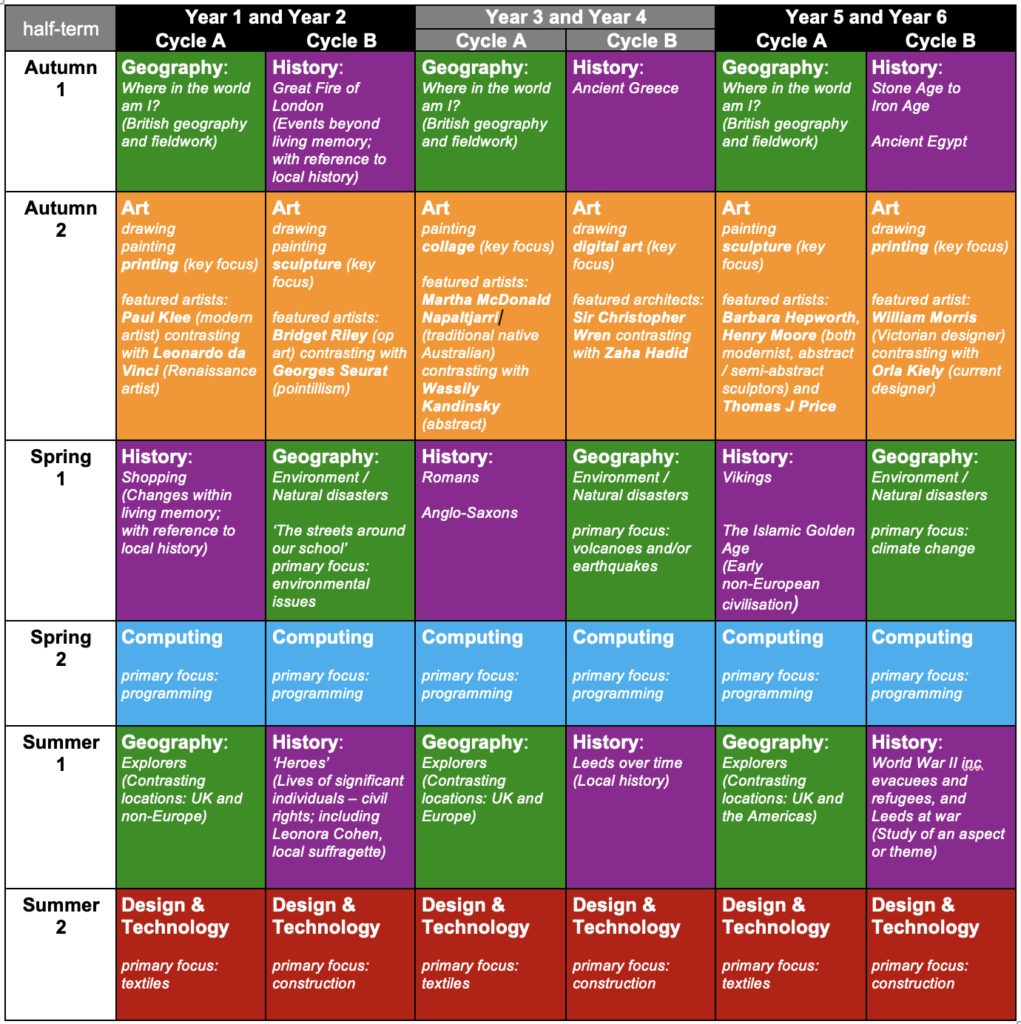
In our Curriculum Guides, we set out a comprehensive series of age-related expectations (AREs). These expectations are what teachers need to teach and what children are expected to learn, both for the core subjects (English, Maths and Science) and the foundation subjects. The expectations are based very closely on the National Curriculum.